Untangling knots thanks to a successful concept
An interview with Britta Bouziane
21 December 2022
"Concept" - what does that actually mean? Anyone who "only" thinks of wireframes that sketch out the design of a website is leaving out a large part of it: Analysis and communication skills play the main role in an extremely exciting field of work, as our expert Britta Bouziane explains.
Dear Britta, I'm delighted to be talking to you as head of the 3pc conceptualisation department: To get a better understanding of your area of work, I would first like to understand what "conceptualisation" actually means ...
We untangle knots, and that enables us to work logically and coherently. And, just as importantly, conceptualisation doesn't just mean that you untangle something, but that you are also able to communicate the solution.
You talk about knots that are untangled - what exactly are you talking about?
The knots we're dealing with are always in the digital space - here at 3pc, it's often about information platforms. In some cases, our customers are tasked with providing low-threshold information to a wide range of different target groups. That can really create a lot of knots!
What skills do you need as a concept developer to untangle such knots?
Very diverse: When it comes to conceptualisation, many people only think of wireframing, which creates a visual template for a design. But that's really only a small part of conceptualisation.
The part before that, namely narrowing down the problems, is the much bigger part. You need a very strong analytical understanding and must be able to listen very well in order to understand customers, which is very important.
And you also need to be able to bring different perspectives together in order to connect people with each other and strengthen their mutual understanding.
How do you do that, bring perspectives together to create concepts - are there any special methods?
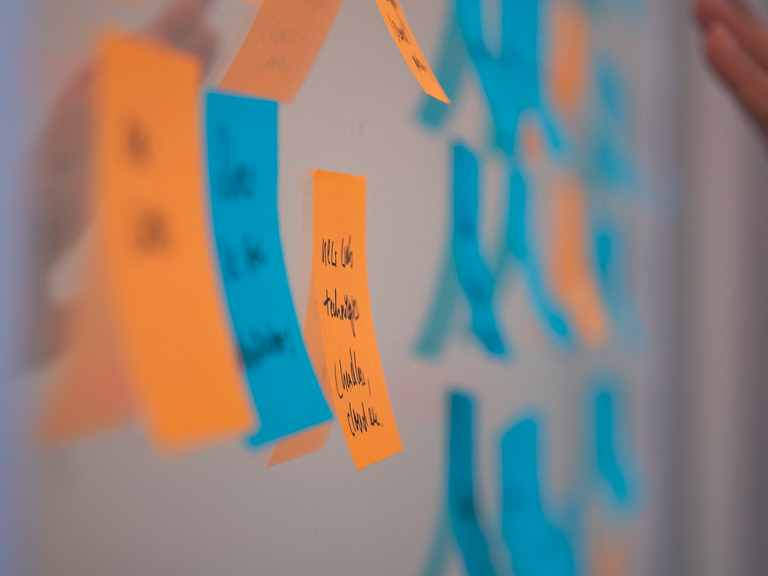
Design thinking is at the heart of our methods: we focus strongly on understanding challenges and problems and, above all, gaining a shared understanding of the challenges.
To achieve this, we don't use an off-the-shelf set of methods, but instead focus on what makes the most sense for each customer. The aim is always to develop an innovative and sustainable solution in the end.
Who takes part in these workshops, the communication experts from the organisations?
The more different and the more diverse, the better! In principle, it's not about having a certain expertise with regard to a solution, but above all about bringing together different perspectives and opinions.
The more insights you have, the more concretely you can find innovations, solutions and ideas for a digital product.
Could you give us an example of what customers come to you with - what do they expect from a workshop?
That always depends on the conceptualisation phase: The more insights you have, the more concretely you can find innovations, solutions and ideas for a digital product.
But if you are still at the very beginning, then you should be very open above all. It may even turn out in the workshop that no digital product is needed at all.
It can also be the case that workshops shed light on individual problems - for example, when customers already have a good digital product but lack the content for it. Sometimes it is unclear how they should prepare the content, whether for reasons of resources, knowledge or because too many instances have to approve a contribution.
Such challenges are tackled in content or editorial workshops, where a kind of practical guide is developed together with the editors.
And once the workshop is over, what happens to the results?
First of all, it is important that everything is actually documented in order to reflect what has been said and to achieve a common understanding. But of course that's not all; there are also recommendations based on the workshop objectives.
The concept also plays a role in the creation of a website. How are you embedded in the context at 3pc?
The concept is one of the first touchpoints customers have with 3pc, it starts very early on. If there is no strategy yet, it is developed first. There is then a close link with the design: the concept is created together in an agile process. We also liaise with the developers to ensure that the technical implementation meets the objectives.
Sounds very exciting! - What would I have to do to become a concept developer?
There are many different ways to do this. On the one hand, you can do an apprenticeship in media design with a focus on conceptualisation - for example here at 3pc. There are also relevant degree programmes that deal with digital communication and, as part of this, with a conceptual focus.
But in our field, career changers can also do a good job - after all, you can acquire the necessary skills in very different ways and also approach conceptualisation in different ways. But one thing remains the same, regardless of whether you come from a communications science, humanities or perhaps a technical background: you definitely need to have great communication and analytical skills. Because these are the be-all and end-all.
About the author
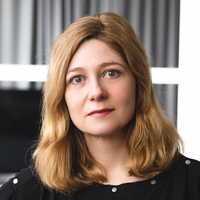
Britta Bouziane has been analysing digital worlds and their users from all angles since the late 1990s and has worked on websites, apps and digital games consoles.
As Senior Concept Designer and UX Strategist at 3pc, she leads the concept team, advises clients on digital products, designs and organises workshops, develops wireframes and prototypes and conducts user research. Her responsibilities range from the development of an initial strategy to ongoing consulting, both in-house and with the client, in order to achieve the optimal implementation of requirements in the digital space.