
"Everyone has to play their part in knowledge management."
In this interview, Arne Leichsenring, former Director Strategy & Finance at 3pc, explains why knowledge management is much more than just providing a large knowledge warehouse, how new structures can be successfully established in organisations and how a culture of teaching and learning makes a decisive contribution to this.

Knowledge management follows a bottom-up logic: it must always be thought of from the smallest possible unit, the individual. How can relevant knowledge be made available to the individual at the right time?
3pc advises organisations and companies on the development of digital strategies and is increasingly working on the topic of knowledge management. What is your experience?
Arne Leichsenring: Knowledge management is an abstract topic that has to be approached individually in each organisation. For example, a public authority that still largely organises its work processes in analogue form may want to gradually digitalise the processes and the associated knowledge and transfer them to large systems. An international company has a large number of systems - here it is more about consistency, quality management and making knowledge available to the right departments across all locations. A start-up, on the other hand, which can plan its system landscape on a greenfield site, is interested in other aspects.
We also often find that various formats for knowledge transfer already exist, such as meet-ups, but that they are not systematically assigned to knowledge management. When developing technical solutions, large systems are often brought into play that do not fulfil the individual requirements of individual departments or locations.
In principle, it is important to make it clear to everyone involved what knowledge management means: knowledge management refers to all strategic or operational activities that are aimed at the best possible use of knowledge as a resource in the organisation.
It is therefore much more than a document management system, a large knowledge warehouse where everyone can store their knowledge and retrieve it when needed. Such a definition is not expedient, as the idea of tapping into employees' knowledge and storing it in systems is too much from an organisational perspective.
It is therefore much more than a document management system, a large knowledge warehouse where everyone can store their knowledge and retrieve it when needed.

So knowledge management needs a multidimensional perspective - where do you start?
It is very important to consider a holistic architecture at the start of a project. This starts with taking stock: what tools do we use? In larger companies, the intranet is often such a classic tool. Or there is a document management system for which a folder structure and certain taxonomies have been established. The first step is then to scrutinise the existing structures: Where might there be overlaps or redundancies? Where do we still have large gaps? Is there perhaps a better form of presentation? The respective level of maturity in dealing with knowledge as a resource also plays an important role. How is the topic received by employees - is it perceived more as a burden or do people even resist it? Data protection aspects always play a role. That's why there is no blueprint.
What characterises successful knowledge management?
Experience from our customer projects shows that knowledge management is an essential part of the work of every employee, but is also very much a management task. In particular, the responsibility for identifying knowledge that is critical to success lies with managers. It is also their task to exemplify the importance of knowledge management in the team, to distribute knowledge and to encourage employees to share their knowledge, e.g. in formats such as Lean Coffee or Daily Stand-ups, and to fill them with life. This means that everyone must do their part to promote knowledge transfer, document knowledge aspects and adhere to processes.
Of course, this requires a clear definition of where to find which knowledge and where it should be stored or shared. The right instruments and tools must be available for this, be it a digital archive, the server structure, the intranet or a customer relationship management system (CRM) for maintaining and documenting contacts. But lean communication tools such as Mattermost or Slack are also important instruments for exchanging knowledge. They offer the opportunity to exchange information quickly and easily and "tap into" the knowledge of colleagues. There is also the general trend that internal communication and file sharing are being increasingly merged and that completely new forms of collaboration are now possible. Solutions such as Microsoft Teams or Nextcloud are the logical consequence of this trend.
Managers should exemplify the importance of knowledge management in the team and encourage employees to share their knowledge in formats such as Lean Coffee or Daily Stand-ups and fill them with life.
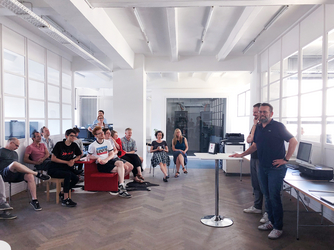
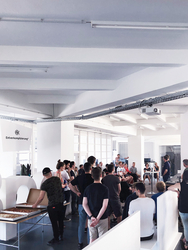
Pizza with knowledge topping. In the 3pc stand-up "Fridays Foodful Thoughts", we share our knowledge just before the pizza: What projects does the editorial team have on the table, what is Creation working on, what new extensions are hot right now?
It is therefore important that knowledge management is not about one big solution - the "egg-laying wool-milk sow" - but about a combination of customised solutions that are coordinated with each other. Redundancies are one of the main hurdles that need to be avoided. Instead: Create clarity. Appropriate processes are essential for this.
In what way?
We use processes to define how the systems are used. It is very important that once these have been introduced, they are continuously reviewed and, if necessary, further developed as part of quality management - this includes all areas from the folder structure in SharePoint to the contact history in CRM. We should regularly ask ourselves whether the quality still fits, where there may be bugs, where we can still link or network knowledge components and how we can constantly improve the findability of knowledge, e.g. through a consistent definition of metadata that favours AI-based search functions.
What about knowledge that is not so easy to document, such as the specific experience or expertise of individual employees, teams or departments?
We have identified this as a very important aspect. Implicit knowledge - as opposed to well-documented, explicit knowledge - in the minds of employees is one of the most important resources of a company. This know-how makes up a large part of the knowledge available in organisations (up to 80%*). This can be ideas, news, experience or (network) contacts that are not documented anywhere. This would be the third aspect alongside systems and processes: digital and analogue knowledge formats that promote the exchange of knowledge. In this context, we are talking about a culture of teaching and learning, i.e. experiencing things, but also passing them on. The spectrum ranges from regular stand-ups to large conferences, but e-learning formats and tutorials can also promote the transfer of knowledge. It should always be considered individually which format makes sense in the respective context.
*Hirotaka Takeuchi and Ikujirō Nonaka: The Knowledge Creating Company
The tacit knowledge - in contrast to the well-documented, explicit knowledge - in the heads of employees is one of the most important resources of a company.
How can such knowledge transfer formats be permanently institutionalised?
The prerequisite for this is active and regular participation by employees, continuous adaptation of the formats and a clear commitment from management to see this form of knowledge exchange as part of the organisational culture - and not just as a "nice-to-have". It must therefore also be the task of management to provide the freedom, resources and capacities for knowledge formats and to motivate employees to actively utilise them.
In the BMBF research project QURATOR , 3pc is working with partners from research and industry to develop practical applications based on artificial intelligence. The topic of knowledge management also plays a role. To what extent can AI provide support here?
Due to the large number of tools that we already use today, a good search is becoming increasingly important in order to be able to access information regardless of the media. Artificial intelligence can make a decisive contribution to this. Our QURATOR partner Semtation , for example, is developing tools that can be used to make knowledge available across companies and also considerably simplify knowledge management processes.
By optimising and simplifying processes, the new technologies also make an important contribution in another respect, namely by motivating all employees in an organisation or company to actively participate in the process.
Due to the multitude of tools that we already use today, a good search is becoming increasingly important in order to be able to access information regardless of the media. Artificial intelligence can make a decisive contribution to this.
Knowledge management is not a sure-fire success. How can the strategy - systems, processes, formats - be translated into practice?
Knowledge management follows a bottom-up logic: it must always be thought of from the smallest possible unit, the individual. How can relevant knowledge be made available to the individual at the right time and in the right way? Next comes the team level, then the department and finally the organisation as a whole. Depending on the level, there are different levels of relevant knowledge that can be stored and retrieved with the appropriate solution. And, of course, there must be technical and content-related persons responsible for driving the topic forward. This can be the task of a separate department or can also be docked within a specific department as a management task. It is important to exemplify the importance of knowledge management within the team. Another important aspect is the time horizon. A well-thought-out roadmap is essential in order to implement the changes gradually and collaboratively - because hard cuts will not work.