Innovative problem solving with design thinking
Develop creative solutions as a team with the user in mind.
The workshop
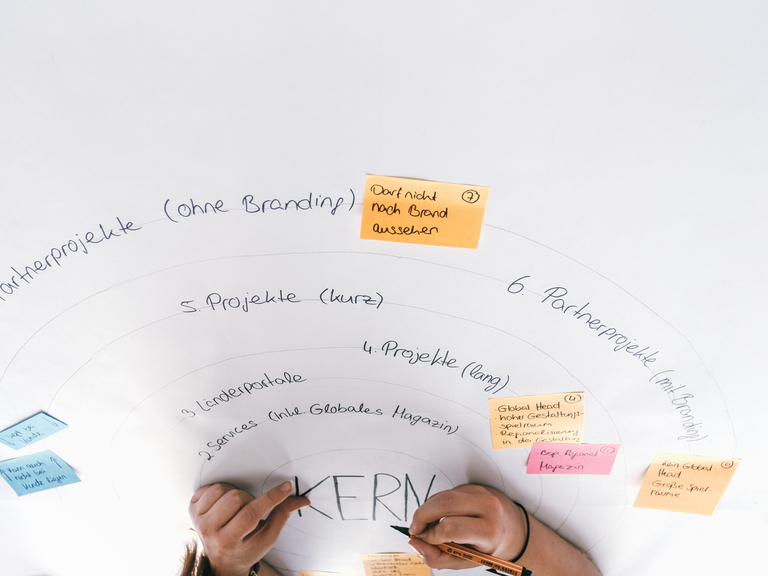
Whether you are looking to optimise digital products, develop new business models or drive forward digitalisation processes, a design thinking workshop offers you unimagined opportunities to find solutions to tricky problems. In the first part of the workshop, we develop a common understanding of the problem. The second part builds on this foundation, in which we use co-creative ideation methods to generate targeted solutions.
We enable you to produce creative results from the user's perspective that are developed in interdisciplinary teams and supported by all stakeholders. Following the workshop, this approach can also be applied to other solutions and sustainably create a culture that puts people at the centre.
The facts
Kick-off meeting
Workshop, documentation and evaluation
Presentation meeting (together 8 h)
Our approach
User-centred
Design thinking focuses on the needs of those who will benefit from the result: This results in creative solutions that convince and inspire.
Innovative
Design thinking creates new ways of thinking and is therefore the ideal framework for innovative ideas.
Collaborative and sustainable
Design Thinking guarantees an equal exchange between all participants and thus leads to a lasting sense of togetherness that can be built on in different work contexts.
Participants
A design thinking workshop is aimed at a group of participants who want to solve problems out-of-the-box in a collaborative working context. A team of stakeholders that is as diverse as possible is recommended for the workshop.

Programme of the workshop
1/ Kick-off meeting
The starting point is a joint familiarisation meeting in which we gain knowledge about your specific challenges and possible goals. We can also use this meeting to plan the workshop in concrete terms.
2/ Workshop part 1
The first part involves bringing together different perspectives and experiences to create a starting point for concrete goals and a clear understanding for the users of the results.
Future journey
The future journey is a simple way for all participants to analyse their own goals. The participants formulate a best-case scenario and a worst-case scenario with a view to the future.
Analysing opportunities and risks
The opportunities and risks analysis sharpens the focus on previously unutilised opportunities on the one hand and reveals which internal and external developments could stand in the way of the project on the other.
Focus group
A moderated discussion along a guideline is a good way to discuss challenges and goals together. The participants have the opportunity to contribute their own experiences and knowledge and at the same time develop empathy for the perspectives of others.
Target group analysis
The target group analysis leads to a common understanding of the future users and their specific needs. In the workshop, the first step is to summarise the most important characteristics of the target groups and then identify their needs.
2/ Workshop part 2
In the second part, the aim is to generate and concretise ideas based on the previously acquired knowledge and to visualise these solutions using prototyping.
World Café
The World Café is a tried and tested method for conducting a solution-orientated discussion on various issues in small groups. Concrete solutions based on the previously generated results can be discussed and deepened in the group. Experience has shown that innovative solutions emerge from the diverse perceptions and opinions.
Walt Disney method
This method is a creativity technique in which the participants get to the bottom of the problem from different perspectives and take on different roles: they alternate between dreamer, realist and critic. The method is not only used to generate ideas, but also for the subsequent optimisation and evaluation of ideas, taking into account a reality check.
Paper prototyping
The paper prototypes are based on the best-rated ideas. The workshop does not aim to produce sophisticated visualisations as a result, but rather to bring initial ideas to life using templates, written explanations and/or simple scribbles. The paper prototypes form the ideal basis for further development and initial testing.
Our team
Our team consists of experts in strategy and conceptualisation with extensive experience in workshops and design thinking.